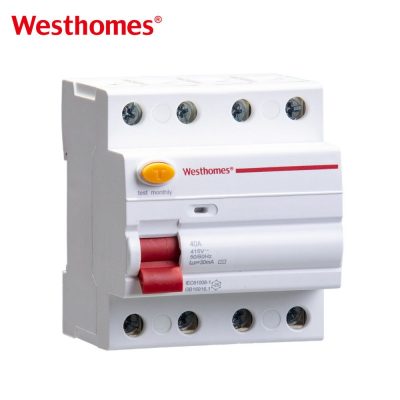
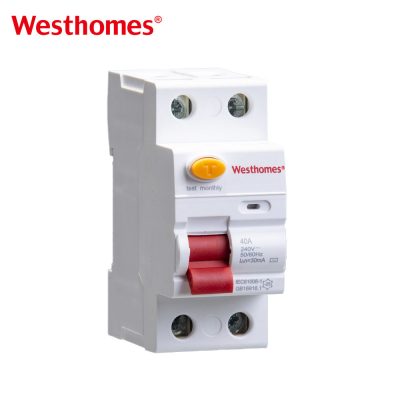
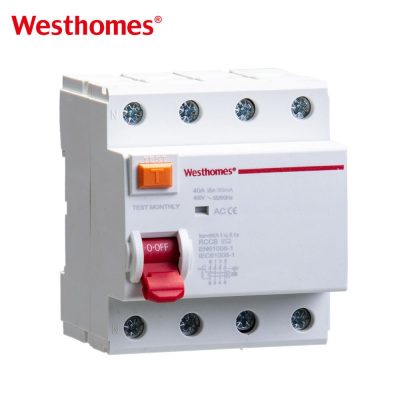
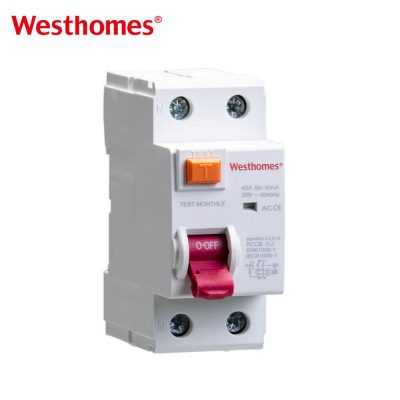
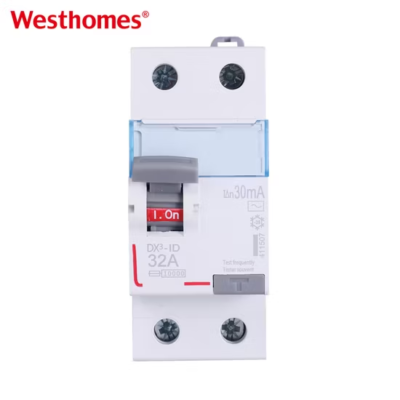
HNB1L-63 RCCB 3P+N | 63A Residual Current Circuit Breaker
This 3P+N RCCB is suitable for high-load and multi-phase environments requiring precise and reliable power protection.
Get quick appointment for technical support!

The HNB1L-63 3P+N Residual Current Circuit Breaker (RCCB) is a high-performance safety device designed for three-phase four-wire systems (3P+N) operating at AC 240/400V, 50Hz.


This 3P+N RCCB is suitable for high-load and multi-phase environments requiring precise and reliable power protection.

The HNB1L-63 ensures efficient operation and superior protection in all kinds of distribution systems.
With a rated current up to 63A and a breaking capacity of 6kA, this RCCB provides advanced earth leakage, overload, and short-circuit protection, making it ideal for both residential and industrial electrical distribution systems.
Engineered for rapid disconnection in the event of electric shock or network leakage, the HNB1L-63 minimizes the risk of injury and electrical fire, ensuring enhanced personal and equipment safety. Its compact structure, electronic trip mechanism, and flame-retardant casing offer a space-saving, safe, and long-lasting circuit protection solution.
Key Features:
Model: HNB1L-63
Configuration: 3P+N (Three Poles + Neutral)
Rated Voltage: AC 240/400V
Rated Frequency: 50Hz
Rated Current: Up to 63A
Breaking Capacity: 6kA
Trip Type: Residual current + Overload + Short circuit
Protection Functions:
Earth leakage protection
Overload protection
Short-circuit protection
Housing: Made from high-impact-resistant, flame-retardant plastic
Structure: Compact design for easy installation
Applications:
Residential buildings
Commercial offices
Industrial distribution panels
Distilleries and factory facilities
Functionality: Also supports infrequent manual switching under normal working conditions
Compliance: Fully meets IEC/EN61009-1 international standards
| Rated current | 10, 16, 20, 25, 32, 40, 50, 63A |
| Rated voltage Ue | AC240V (1P+N, 2P); AC400V (3P+N, 4P) |
| Rated insulation voltage Ui | AC415 |
| Rated impulse withstand voltage Uimp | 4kV |
| Rated frequency | 50/60Hz |
| Number of poles | 1P+N, 3P+N |
| Module size | 36mm, 72mm |
| Circuit type | AC type, A type, B type |
| Breaking capacity | 6000A, 10000A |
| Rated residual current I△n | 10mA, 30mA, 100mA, 300mA |
| Rated residual operation current | 10, 30, 100, 300mA |
| Optimum operation temperature | -5ºC to 40ºC |
| Terminal tightening torque | 2.5-4N/m |
| Terminal capacity (top) | 25mm² |
| Terminal capacity (bottom) | 25mm² |
| Electro-mechanical endurance | 4000 cycles |
| Mounting | 35mm DIN rail |
| The very new tripping structure makes more in safety | |
| Suitable busbar | PIN busbar |
| Standard | IEC61008-1 |
| Model NO. | HNB1L-63 |
| Arc-extinguishing Medium | Air |
| Structure | MCB |
| Type | Circuit Breaker |
| Certification | ISO9001-2000, CE, CB, CCC |
| Ka | 6ka, 10ka |
| Voltage | AC240V/AC400V |
| Specification | 10A-63A |
| Origin | China |
| Production Capacity | 365000 |
| Speed | Normal Type Circuit Breaker |
| Installation | Fixed |
| Poles Number | 3p+N |
| Function | Conventional Circuit Breaker, Circuit-Breaker Failure Protection, Overcurrent Protection, OVP(Overvoltage Protection) |
| Production Line | 100% Automic |
| Cooperation Type | OEM ODM |
| Transport Package | Standard |
| Trademark | Westhomes |
| HS Code | 8536300000 |
See Ultimate Guide to Residual Current Circuit Breakers (RCCBs) for a deeper dive into residual current.
See WSB5L Series 1P+N RCCB Residual Current Circuit Breaker for a deeper dive into residual current.
See 6kA/10kA RCCB Residual Current Circuit Breaker –WSB5L Series for a deeper dive into residual current.
See CE CB Approved 4p Breaker-Protector RCCB Residual Current Operated Circuit Break for a deeper dive into residual current.
It is a three-phase four-pole RCCB (residual current circuit breaker) in the HNB1L-63 series, designed for earth-leakage protection in three-phase distribution boards. It switches L1, L2, L3 and N together and trips on detecting an imbalance between incoming and outgoing current, protecting people and property from electric shock and earth faults.
The 3P+N version is a pure RCCB (residual-current-only protection) for three-phase circuits, while the 1P+N version described as an RCBO integrates overcurrent protection in a single-phase final unit. The 3P+N RCCB must be paired with upstream MCBs/MCCBs for overload and short-circuit protection, whereas the RCBO is self-contained.
The 3P+N construction is for three-phase four-wire systems, typically 400 V line-to-line and 230 V line-to-neutral at 50/60 Hz. It can protect a panel feeding a mixture of three-phase motors/compressors and single-phase 230 V sockets or lighting. Confirm the exact rated voltage on the nameplate.
No. As a pure RCCB it only responds to residual (earth-leakage) current. An upstream MCB, MCCB or group of MCBs must provide overload and short-circuit protection, with proper discrimination so that downstream faults are cleared by the downstream device rather than the RCCB.
Typical options are 30 mA for personal protection, 100 mA for equipment protection, and 300 mA for fire protection and upstream selectivity. For three-phase installations with long cable runs or VFD loads, choose sensitivity and type (AC/A/F/B) according to the actual leakage level and electronics present.
Type AC only detects sinusoidal AC leakage and is unsuitable for electronic loads. Type A adds pulsating DC detection. Type F covers composite residual currents from single-phase frequency-converter appliances. Type B adds smooth DC detection and is required for EV chargers, PV inverters and three-phase VFDs. Match the type to the load to avoid nuisance trips or missed trips.
Snap onto a 35 mm DIN rail. Connect incoming L1, L2, L3 and N to the upper line terminals in the marked order, and outgoing circuits to the lower load terminals. All four conductors must pass through the internal core-balance CT; do not bypass the neutral or cross neutrals between RCCB groups. Use suitable lugs and torque settings.
Common causes are capacitive leakage from long motor cables and EMC filters, pulsating/smooth DC leakage from VFDs when using a Type AC device, shared or mixed neutrals, damp insulation, and lightning surges. Diagnose by isolating loads one by one and measuring insulation resistance; upgrade the RCCB type or sensitivity rather than disabling protection.
Yes, 3P+N RCCBs are commonly used as the main or group RCD in three-phase residential and commercial services. For best selectivity, use a time-delayed (Type S) unit upstream and instant 30 mA units on final circuits, so a fault in one final circuit does not shut down the whole installation.
Press the "T" test button monthly while powered; the device must trip immediately. Periodically (e.g. during the periodic electrical inspection required by local wiring rules), a qualified electrician should measure actual tripping current and time with a calibrated RCD tester. Replace the device if it fails the test, trips without a clear fault, or shows physical damage.
* indicates a required field


 155 MB