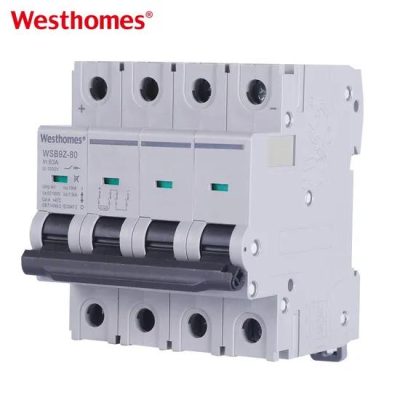
WSB1Z-63 Moulded case circuit breaker
WSB1Z-63 is one of updated type MCCBs researched and developed by the company by using advanced design and manufacture technology internationally.
Get quick appointment for technical support!

WSB1Z-63 series MCB is one of updated type MCCBs researched and developed by the company by using advanced design and manufacture technology internationally.



WSB1Z-63 is one of updated type MCCBs researched and developed by the company by using advanced design and manufacture technology internationally.
WSB1Z-63 series DC mini circuit breakers are applied at direct current circuit system, with rated operation voltage DC250V/500V/750V/1000V, rated current up to 63A, to make protection of overload and short circuit,also for infrequent changeover for the lines.The breakers are used at places of commercial office,residential and similar buildings. The product meets standards of GB10963.2 and IEC60898-2.
| Frequency | 50Hz/60Hz |
| Pole | 1, 2, 3, 4P |
| Voltage | DC250V/500V/750V/1000V |
| kA | 6kA |
| Amps | 6-63A |
| Width | 18, 36, 54, 72mm |
| Mounting | Din rail |
| Model Ics/Icn) | pole | rated current(A) |
| WSB1Z-63 (6kA/6kA) | 1P | 6A-63A |
| WSB1Z-63(6kA/6kA) | 2P | 6A-63A |
| WSB1Z-63 (6kA/6kA) | 3P | 6A-63A |
| WSB1Z-63(6kA/6kA) | 4P | 6A-63A |
For a closer look at circuit breaker, read Manufacturer AC 50Hz/60Hz Wsb5-40 Low Voltage MCB Circuit Breaker.
For a closer look at circuit breaker, read Chinese Factory AC 50Hz/60Hz 3p MCB Wsb1-125 Mini Circuit Breaker.
For a closer look at circuit breaker, read Wsb1-80 Westhomes Miniature Low Voltage Circuit Breaker 6ka/10ka 6-80A 4p MCB.
For a closer look at circuit breaker, read Wsb1-80 Westhomes Miniature Low Voltage Circuit Breaker 3p 6-80A 230/400V/AC MCB.
For a closer look at circuit breaker, read Hot Sale AC 50Hz/60Hz 2p Wsb1-80 Series Mini Circuit Breaker.
For a closer look at mccb, read Wsb1-63 10ka 6-80A 230V/400V/AC 6ka MCB with CE.
For a closer look at circuit breaker, read Factory MCB Price Wsb9sz-125II Series Moulded Case AC Mini Circuit Breaker 3p+N.
For a closer look at circuit breaker, read Westhomes Low Voltage AC 230V/400V 3p MCB Mini Circuit Breaker.
For a closer look at circuit breaker, read Factory Smart Intelligent AC Circuit Breaker Wsb5 (L) -40 MCB ODM OEM.
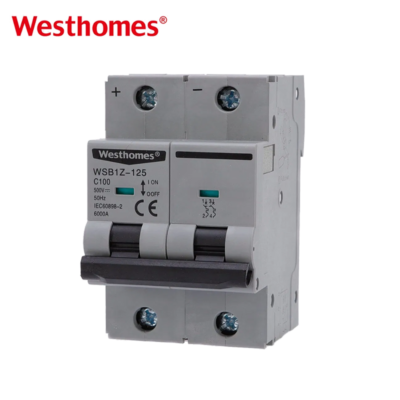
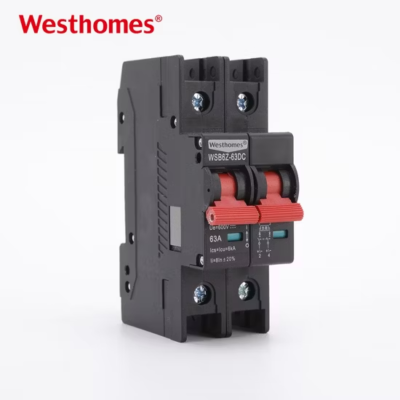
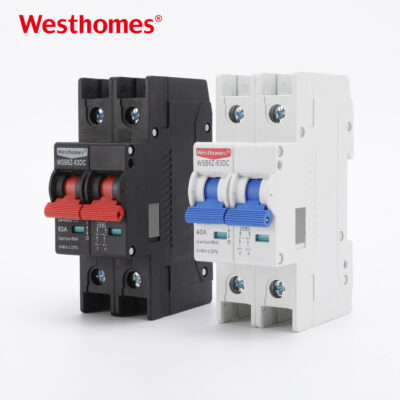
A 2P 63A DC miniature circuit breaker is a DIN-rail protective device that opens both poles of a direct-current circuit on overload or short circuit, rated to carry 63 A continuously. The two poles break the positive (+) and negative (−) conductors of a single DC circuit together. It is commonly used as a compact protection and isolation device for residential photovoltaic arrays, battery systems and other low-voltage DC installations.
DC current never crosses zero, so an arc between opening contacts does not extinguish by itself and can persist, melt contacts and start a fire. A DC MCB counteracts this with a magnetic blowout coil that pushes the arc into an arc chute with cooling splitter plates, stretching and breaking the arc until it dies. This is why it is certified only for its rated DC voltage and cannot be replaced with an ordinary AC MCB on the same circuit.
The maximum voltage depends on the specific model rating, but a 2P DC MCB is typically rated for the voltages common in residential solar (for example up to 500–630 V DC per pole arrangement, depending on product). Because two poles in series share the interruption, the voltage rating is often doubled compared with a single-pole version at the same contact design. Installers must confirm the device's stated DC voltage exceeds the array's maximum open-circuit voltage at the lowest design temperature.
The 2P design means one handle simultaneously opens both the positive and negative conductors of a circuit. In a single PV string this is the safest arrangement because it isolates the string fully: after tripping, neither conductor remains at potential relative to the other, reducing shock and arc risk during maintenance. A single-pole breaker on a DC circuit would leave the opposite conductor live, which is why double-pole breakers are standard for DC isolation.
63 A is the continuous current the breaker can carry without thermal tripping at the reference ambient temperature. It should be selected above the normal operating current of the string or battery circuit but low enough to protect the connected cables, and derated for high temperatures inside the box. The magnetic trip threshold (set by the C or D curve) determines the fault current at which it snaps open instantly.
In a residential PV system, the 2P 63 A breaker is installed between a solar string (or the combiner output) and the inverter's DC input, providing overcurrent and short-circuit protection while also serving as a visible disconnect for that string. It isolates one string for troubleshooting without affecting the whole array, and its double-pole opening ensures both DC conductors are safely broken. The rating must match the string short-circuit current and inverter input current.
Connect the positive (+) and negative (−) conductors to the terminals marked for the array/line side, and the inverter/load side to the output terminals, keeping polarity exactly as marked because DC devices are polarity-sensitive. The breaker mounts on a 35 mm DIN rail, and the PV cables must be of adequate cross-section with proper lugs and torque. Reversed polarity, undersized cables or loose connections cause overheating and unreliable tripping.
The breaker protects the DC cabling between the array and the inverter and must interrupt any fault current the array supplies in sunlight without damaging the inverter. Its breaking capacity must be greater than the available PV short-circuit current, and its tripping curve should be chosen to ride through the inverter's start-up inrush while still clearing genuine faults. It complements — but does not replace — the inverter's own electronics and any code-required DC disconnect or rapid shutdown.
Unexplained trips are usually from inverter inrush on cold, bright mornings, an incorrect trip curve (C vs D), a hot enclosure derating the 63 A rating, or undersized/loose DC connections causing extra current. To diagnose, measure the actual current against the rating and the calculated fault level, check box temperature, verify cable size and torque, and confirm the curve suits the inverter. If the trip current is at the fault level, locate the short circuit or ground fault before resetting.
The breaker is designed to IEC 60947-2 for low-voltage circuit breakers and installed per IEC 60364-7-712 for PV power supply systems, and it carries CE/CB type approval. Westhomes offers OEM and ODM services so ratings, labels and packaging can be adapted to a customer's brand. Typical applications are residential rooftop PV, small commercial systems and battery energy storage circuits. Routine maintenance involves inspecting and retorqueing terminals, checking for heat marks, verifying operation after a fault, and replacing the unit if contacts show arc erosion or it fails to hold rated current.
* indicates a required field

 2 MB